


Light, Shade, and Sanctuary
Rethinking washroom design through illumination is the subtle tool of final perception in design.
In high-functioning design ecosystems, washrooms are no longer peripheral zones—they are compositional challenges where technical precision must meet sensorial finesse. Within these compact yet complex interiors, lighting assumes an architectural role: not merely to illuminate, but to articulate mood, volume, and detail with exacting purpose.
When Le Corbusier described architecture as “forms assembled in the light,” he pointed to what lighting designers have long understood: space does not exist without its luminous context. In the washroom—arguably the most intimate spatial envelope within a home or hospitality environment—this context calls for a gentler, more precise hand. Here, lighting is not just a finishing touch, but a subtle yet essential interface between user and environment.
In this most personal of spaces, lighting design cannot afford to be one-dimensional. General illumination alone falls short. Instead, the contemporary washroom calls for a blend of ambient, task, and accent lighting that is at once functional and poetic. Yet, these labels—useful as they are—don’t quite capture the sensory richness that a truly well-lit washroom can offer.
“The washroom is where people look at themselves the most, often with their guard down,” says one leading European lighting consultant. “You are lighting not just skin, but mood and self-perception.” That is where concepts like color rendering index (CRI) and correlated color temperature (CCT) begin to matter.
High CRI lighting—typically above 90—is essential in spaces where accurate facial tones are important. A mirror-lit washroom with poor CRI may cast you in sickly hues; a high-CRI light flatters the skin, reveals material finishes as intended, and adds emotional clarity to function. The CCT, or the color temperature of the light, also has to be carefully chosen. Lighting in the range of 3500K to 4000K is ideal—cool enough to wake you up, warm enough not to sterilize the space.
Another subtle, yet often overlooked, metric is luminous intensity. While standards recommend around or roughly 750–1000 lux at the vanity for tasks like shaving or makeup, the rest of the space need not be as bright. Designers often find magic in the contrast—the soft glow of a pendant lamp over a freestanding tub, the shadowed grace under a floating vanity, the discreet shimmer of LEDs recessed in niches.
Shade, in this context, becomes a compositional element. Not a mistake to correct but a texture to be designed. “We shape light as much by what we illuminate as by what we choose not to,” says a friendly lighting designer whose residential projects often resemble stage sets. In luxury washrooms, where materials such as brushed metal, matte ceramics, veined marble, and ribbed glass are used, the interplay of shade creates dimensionality. A backlit onyx wall, for example, sings only when the surrounding areas fall into a hush of shadow. It is in that contrast that luxury whispers.
Techniques such as wall grazing, indirect uplighting, and cove lighting allow for the gentle shaping of brightness levels without harsh visibility. Cove lights can soften ceiling edges. Recessed LEDs behind mirrors give a floating effect. Even lighting below a vanity or within shelving recesses can introduce visual rhythm and spatial layering.
A particularly rich dialogue emerges between light and material. A white terrazzo counter will react differently to light than a dark-stained wood one. Terrazzo may sparkle under a 3000K directional light, while wood absorbs warmth, giving a comforting, grounded feel. This material interplay is increasingly becoming central to washroom design, as architects use lighting not just to make things visible, but to make them tactile.
It is not just about artificial sources. Natural light, though often elusive in urban washroom settings, remains the most luxurious and forgiving of all illumination. Skylights, clerestory windows, or even cleverly borrowed light from adjacent rooms can flood a washroom with warmth and softness that no LED can quite replicate. Smart designers today use translucent glass blocks, frosted partitions, and even polycarbonate light channels to pull daylight into interiors. When privacy is paramount, electrochromic or “smart” glass allows for switchable transparency, offering daylight without exposure.
Washrooms without windows can still emulate the psychological effects of natural light through tunable white lighting systems—LEDs that shift in color temperature through the day to mirror circadian rhythms. At 6am, a cooler, bluish light mimics dawn. By 8pm, the system has transitioned into warm, amber tones that signal wind-down. It’s not gimmickry; it’s design with empathy.
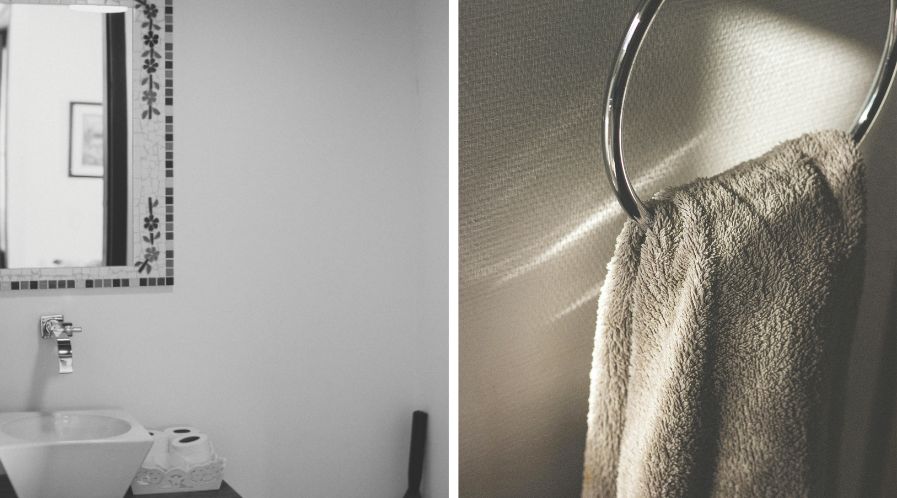
Mirrors, of course, are the co-conspirators in all of this. The mirror, as both a functional tool and a visual focal point, must be lit thoughtfully. Overhead lighting, though tempting, is the cardinal sin of mirror illumination—it casts deep shadows under the eyes and chin, giving even the most well-rested face a haggard appearance. Instead, side-mounted vertical fixtures or integrated LED strips at eye level offer balanced, frontal lighting that is both flattering and precise. Today’s high-end mirror systems incorporate dimming, defogging, CRI 95+ lighting, and even programmable scenes that respond to time of day or personal routine.
In luxury residential settings and boutique hospitality, mirrors are now being treated as luminous objects. Some designers have created backlit panels that hover on washroom walls like modern altarpieces—glowing with quiet authority, creating soft halos that gently bounce light around the space.
Technology, naturally, plays a growing role. With smart lighting systems now integrated into most home automation ecosystems, washrooms are being programmed to respond not just to switches, but to moods. Voice-controlled lighting, app-based dimmers, motion sensors for night-time use, and preset lighting ‘scenes’ are commonplace. A morning scene might flood the space with 4000K daylight tones, while an evening routine dims the lights to 2700K, warming the room to a spa-like aura. The humble washroom has entered the domain of the theatrical, where lighting can direct attention, deepen serenity, or invigorate the spirit.
Commercial projects are leading the way. A boutique hotel in Milan, for instance, recently introduced dynamic RGBW lighting in its guest washrooms. When a guest enters, a gentle blue tone fades into a soft white as occupancy is detected. As one stands before the mirror, the lights automatically adjust to full brightness. Upon exit, the room dims to a muted lavender, creating a memory of presence. It’s not just automation—it’s a form of storytelling.
This sensory layering isn’t reserved for the elite. Even modest residential washrooms benefit from basic lighting design principles. One must simply think of light as a building material—no less architectural than a wall, no less sculptural than a basin. “We’ve long stopped thinking of washrooms as hardware stores,” jokes a London-based lighting consultant. “We’ve started thinking of them as emotional chambers. That changes everything.”
Indeed, the most effective washroom lighting schemes today combine art and science. Many consider footcandle recommendations from the IES (Illuminating Engineering Society) but also observe how a shadow falls across a cheekbone. They understand the efficiency of LED drivers and the nuance of diffusion films. They work in coordination with material palettes and plumbing layouts. They anticipate glare from chrome finishes and calculate how light bounces off tile grout.
Light is no longer simply the cherry on top to be applied after the fixtures are in. It is integral, foundational—woven into the blueprint, the mood board, the client brief. From spa-like ensuites to compact powder rooms, the best washroom designs are those that radiate with thoughtful purpose. They don’t shout. They whisper. They wrap light around the user as though handing them a towel, gently, respectfully, reverently.
In the end, light and shade are not just tools of visibility. In the washroom, perhaps more than anywhere else, they become instruments of dignity. They let you meet your reflection—gently, even kindly, with just enough light to feel human again. Let’s face it, nobody wants to be judged by overhead lighting before their first cuppa.
Tags: Architectural Lighting, Lighting Design, Washroom Interiors